


In contemporary business environments, networks are no longer isolated systems; they are integral to the operation, scaling, and innovation of businesses. As the demands from users, applications, and platforms increase, networks must respond in an intelligent and efficient manner. This is where Network Automation and Orchestration Platforms become essential.
This post examines how these platforms function as the central nervous system for modern networks by connecting people, systems, and infrastructure into a unified, automated workflow.
Who Makes the Requests: Interfaces & Consumers
At the top of the architecture, northbound integrations initiate requests into the automation platform. These include:
- ITSM Systems: Automate workflows and logic (e.g., BMC, ServiceNow).
- Ticketing & Change Management: Tools like ServiceNow, Remedy, ManageEngine create change events for automation.
- Inventory & CMDBs: Define network state using NetBox, IPAM, configuration databases.
- CRM Systems: Align provisioning with business context using Salesforce, Jira.
- DevOps & SRE Toolchains: Automate CI/CD processes using GitLab, GitHub, Jenkins, Ansible, Terraform, Python scripts.
These systems interact with the network via APIs, workflows, or event triggers.
 How Automation Gets Smarter: The Intelligence Layer
At the core of the system is the automation and orchestration engine, which acts as the central intelligence that converts requests into tangible changes while ensuring oversight and control.
Its functionalities are augmented by:
- Sources of Truth: Tools such as NetBox, CMDBs, and IPAM systems, which define the intended state of the network.
- Discovery: Techniques like active scanning or integrations that identify the actual deployed infrastructure.
- Telemetry: Real-time analytics, including SNMP, streaming telemetry, or syslog, which provide insights into network performance.
- Service Topology Awareness: The ability to map the relationships between users, services, and infrastructure, thereby preventing indiscriminate modifications.
This intermediary layer enables the automation platform to validate intent, detect deviations, and facilitate closed-loop remediation.
 Where the Work Happens: Target Network Domains
Below the orchestration engine lies the southbound integrations, which play a crucial role in connecting to the actual network infrastructure:
- Cloud Controllers: AWS, Azure, GCP, Alkira, Aviatrix—responsible for automating VPCs, routing, and policy management.
- Data Centers: Encompassing both physical and virtual infrastructure—Cisco, Arista, Juniper, VMware NSX.
- SD-WAN/SASE: Platforms such as Cisco SD-WAN, VeloCloud, Versa, and HPE Aruba that manage secure edge and transport overlays.
- Campus Networks: Wired and wireless access systems provided by vendors including Cisco, Aruba, Dell, HP, and Juniper.
- Security Infrastructure: Providers like Palo Alto, Fortinet, Cisco, Zscaler, Tufin—ensuring automated firewall and access policy enforcement.
- Network Services: Including DNS, DHCP, and IPAM (Infoblox, Bluecat, NetBox), load balancing (F5), among others.
These systems carry out critical functions—implementing configurations, enforcing policies, and reporting status back to the orchestration engine.
 The Big Picture
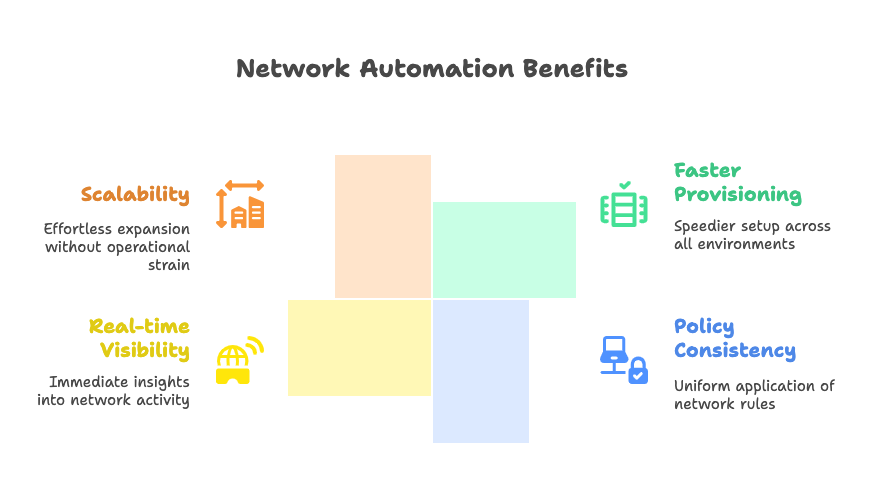
The automation platform bridges business intent and infrastructure execution, enabling:
- Faster provisioning across environments
- Consistent enforcement of network policies
- Real-time visibility
- Scalability without overloading your operations team
Whether you’re deploying a hybrid cloud, improving security posture, or avoiding manual SSH—this architecture scales with you.
 Need Help Building This?
At MZS Networks, we are dedicated to designing and implementing intelligent automation frameworks tailored to your infrastructure, whether it is cloud-based, on-premises, or hybrid environments.
Our services encompass NetBox integrations, CI/CD pipelines, SD-WAN policies, and real-time telemetry, ensuring a transition from static to dynamic operations, one workflow at a time.
Disclaimer
The companies, platforms, and technologies mentioned in this article, such as AWS, Azure, ServiceNow, GitHub, Cisco, among others, are included strictly for illustrative and informational purposes.
MZS Networks does not endorse, sponsor, or receive compensation from any of the brands or vendors cited.
All trademarks and product names are the property of their respective owners.
