


Network automation has become essential as networks expand and grow in complexity. Automating processes effectively can provide a strategic benefit. However, the process of automation varies among organizations.
Typically, organizations progress through different stages—from using isolated scripts to implementing fully abstracted, self-service models. Understanding your position on the automation maturity curve can assist in determining appropriate next steps.
Here is a breakdown.
Stage 1: Limited to No Automation
This is the point at which the journey commences—and where many networks continue to function today.
- Approach: Utilization of manual CLI commands, copying and pasting configurations, tracking via spreadsheets
- Tools: Basic scripts (if utilized), ad-hoc Python programming, Notepad++
- People: Individual engineers performing tasks according to their personal methods
During this stage, the focus is predominantly on effort and experience. There is limited standardization, minimal collaboration, and a lack of centralized visibility into changes.
 Risks: Elevated error rates, prolonged change implementation times, burnout among personnel, and an absence of scalability.
Stage 2: Task Automation
Here, engineers begin to automate specific, repetitive tasks—typically to reduce their own workload.
- Approach: Scripts or playbooks for VLAN creation, port setups, backup pulls
- Tools: Ansible, Python, Netmiko, Nornir
- People: Network engineers with basic scripting knowledge
You’ll see version control (hello, Git) enter the picture. However, these automations are usually limited in scope, and execution still requires human initiation.
 Win: Time savings and reduced fat-finger mistakes.
Stage 3: Process Orchestration
We are now discussing end-to-end workflows—automation that integrates teams and systems seamlessly.
- Approach: Integrating multiple automation steps into a sequence: validate > push > verify.
- Tools: StackStorm, Cisco NSO, Ansible Tower, Jenkins, REST APIs.
- People: Cross-functional teams (NetOps, SecOps, DevOps).
For example, a firewall rule change request submitted through ServiceNow triggers automated validation, deployment, and audit logging—eliminating the need for manual SSH access to devices.
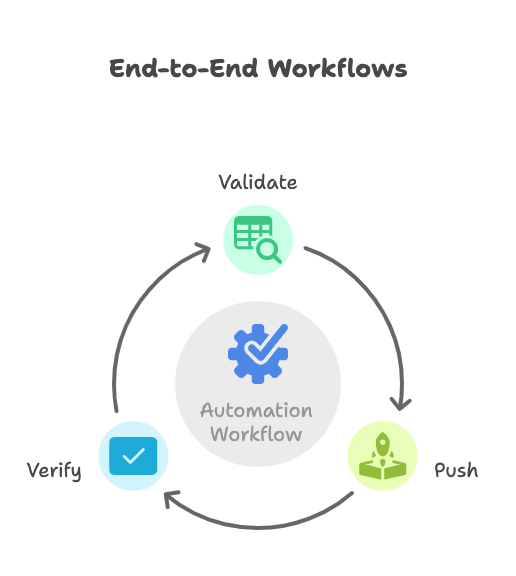 Shift: Transitioning from task automation to process automation.
Stage 4: Self-Service Networking
This represents the ideal scenario: network as a service, concealed behind APIs, portals, or catalogs.
- Approach: Developers or business users can provision necessary resources via a user interface or API.
- Tools: Terraform, custom service portals, ServiceNow, CI/CD pipelines.
- People: End users, not exclusively engineers.
Consider the scenario where a developer initiates a new application and, as part of their development pipeline, the required network segments, policies, and DNS entries are automatically provisioned within established guardrails.
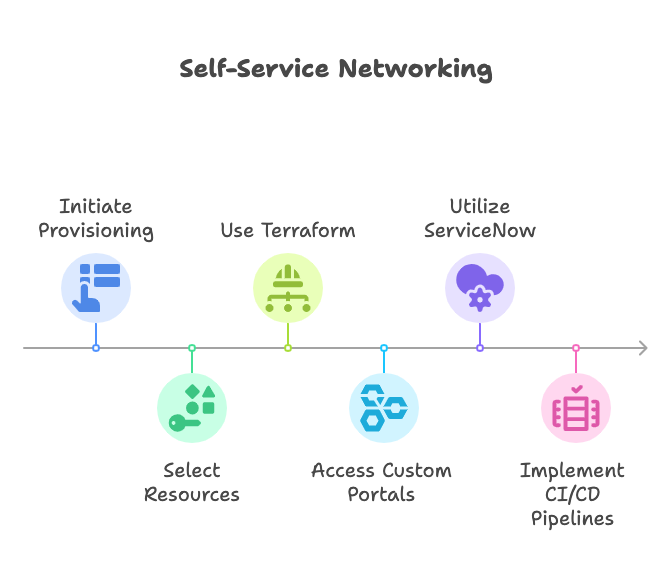 Result: Enhanced innovation, reduced support tickets, and a network that scales in alignment with business growth.
So, Where Are You?
Teams often struggle with task automation and orchestration due to limitations in tooling, culture, or visibility. The solution involves:
- Standardizing effective processes
- Creating repeatable workflows across domains
- Offering services via safe, scalable interfaces
How MZS Networks Can Help
At MZS Networks, we assist organizations in progressing through various stages of automation, from isolated playbooks to developing a comprehensive self-service portal.
Our services include:
- Experience with multi-vendor and hybrid networks
- Modular automation design (Ansible, StackStorm, Terraform)
- Deep integration strategies (NetBox, ITSM, SD-WAN, Cloud)
To evaluate your current maturity and create a roadmap for future automation, visit mzsnetworks.com.
Disclaimer
The companies, platforms, and technologies referenced in this article (including but not limited to GitHub, Cisco, NetBox and others) are mentioned solely for illustrative and informational purposes.
MZS Networks does not endorse, sponsor, or receive compensation from any of the brands or vendors cited.
All trademarks and product names are the property of their respective owners.
