


Nowadays, it is highly important for network operators to monitor and control the performance of their devices in real-time. In the past, SNMP (Simple Network Management Protocol) has been the most common way of getting information from our network. But as new requirements for the network continue to drive up along with health and data monitoring, classic thinking and strategies are being put to the test.
Telemetry’s push-based approach also provides quicker, near real-time analysis, creating an environment where networks can be managed proactively rather than reactively. The question raises; can it replace SNMP? We will examine these methods and discuss their differences, pros and cons, and the future of network monitoring automation in this article.
Understanding SNMP: The Standard Method
Effective monitoring is the cornerstone of network management. The standard for network devices data collection and reporting is SNMP, which gathers performance metrics, traffic data, and operational health by polling individual network devices.
Although used for decades, the pull-driven nature of SNMP has limitations. Continuous polling of devices incurs high costs and may lead to latency issues, potentially omitting crucial real-time data that is essential for troubleshooting or optimizing performance.
Telemetry, on the other hand, employs a push model in which network devices automatically transfer data to monitoring systems. This provides second-by-second data, allowing the network to be more visible and responsive with an up-to-the-minute snapshot of its status.
As IoT devices become increasingly prevalent in today’s networks, fast and effective methods for data collection are ever more critical when network automation is essential.
The issues SNMP faces in today’s networks
Numerous corporate networks continue to use SNMP, even with the emergence of telemetry, especially in legacy systems where moving to modern tools could require substantial infrastructure changes.
Though basic, SNMP has issues. Its regular polling can delay data retrieval, reducing the accuracy of network condition awareness. This lag is problematic for networks needing real-time monitoring and quick responses, like IoT-driven and highly automated networks.
SNMP’s scalability is another challenge; polling thousands of devices can lead to network congestion and stress the management system and devices.
In contrast, telemetry provides lower overhead for real-time data, yet it presents some challenges. The streaming of real-time data can overwhelm monitoring systems with excessive information, making it difficult to distinguish meaningful signals from noise. Furthermore, if not implemented correctly, telemetry can be resource-intensive and necessitates stable connectivity.
For network engineers, balancing these strategies presents challenges due to the network’s size, real-time traffic requirements, and other infrastructure constraints.
Telemetry: The Emerging Trend in Real-Time Monitoring
Numerous network managers are exploring hybrid approaches that integrate SNMP with telemetry to address their challenges.
Telemetry is increasingly integrated into modern network automation systems, allowing engineers to combine real-time monitoring with traditional SNMP checks. This method gathers real-time data without completely abandoning SNMP, which remains necessary for certain use cases, especially in always present legacy systems.
Telemetry data is frequently combined with AI and machine learning algorithms that assess the incoming data, filtering irrelevant information and highlighting key performance metrics. This enables network engineers to access only essential insights in real-time, reducing data overload by filtering out unnecessary information and highlighting key performance metrics. This ensures that network engineers see only critical insights in real-time, alleviating data overload.
Emerging network standards also utilize telemetry as a key data collection technique, providing real-time access to essential components, such as IoT devices, sensors, and industrial equipment.
The shift to telemetry is advancing rapidly; however, SNMP and telemetry are likely to coexist sensibly for the foreseeable future solution.
Evaluating Telemetry’s Benefits and Drawbacks Against SNMP
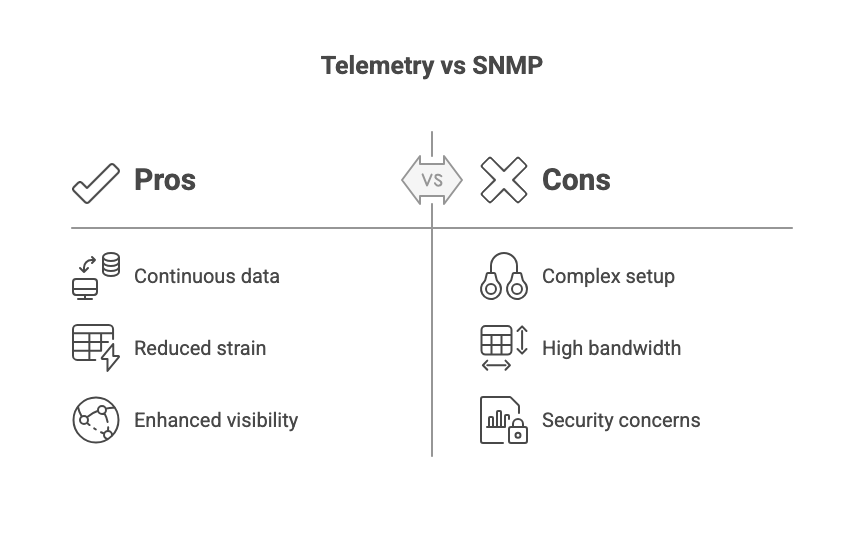
Advantages of Telemetry:
- Telemetry provides continuous data streaming, therefore guaranteeing that network performance is always under observation without waiting for poll intervals.
- Removing the need for continuous polling allows telemetry to alleviate the strain on network resources and devices.
- Enhanced visibility of network activities, particularly for real-time troubleshooting, provides a more precise and detailed perspective.
The drawbacks of Telemetry are:
- Data Overload: Especially in the absence of automatic filtering and analysis tools, the continuous flow of data can overwhelm monitoring systems.
- Using telemetry-based systems requires modern infrastructure, which can be complicated and expensive for legacy systems.
- Constant data flow requires greater bandwidth, which can be problematic in settings with limited resources.
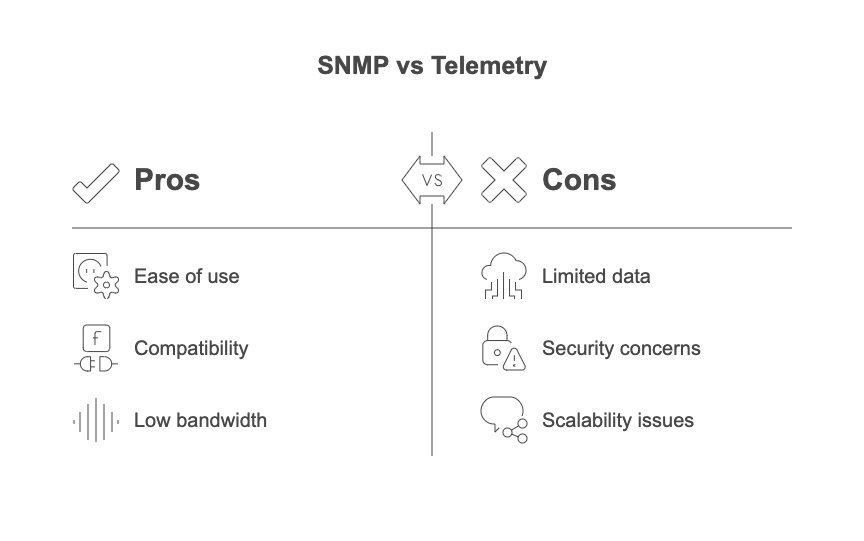
 SNMP offers the following advantages:
- SNMP is easy to use and does not require the complex setup that telemetry calls do.
- Compatibility: The protocol most frequently used among network management tools and devices is SNMP.
- Low Bandwidth: SNMP uses less bandwidth than continuous telemetry since data is transmitted only when requested.
SNMP’s shortcomings are:
- SNMP’s regular polling limits real-time visibility and may result in missing important performance data.
- As networks expand, SNMP’s polling cost can strain the infrastructure and lead to inefficiencies.
 Telemetry takes the lead
The growing demand for real-time network analytics will help technologies like 5G, IoT, and SD-WAN raise the value of telemetry. In changing surroundings, telemetry offers the flexibility and quick response required; its interaction with artificial intelligence and automation will simplify network management.
Telemetry should become more popular as businesses improve their networks to control continuous data flows. By including artificial intelligence analytics, telemetry systems can automate a good amount of network management, so reducing reliance on human involvement and enabling networks to have self-healing properties.
Still, SNMP is probably going to be important for quite some time. It is still absolutely vital for network monitoring since old systems and devices are still in use.
Conclusion
The debate between telemetry and SNMP becomes increasingly noticeable as networks continue to grow more complex and expansive. Although SNMP has been an invaluable tool for decades, telemetry’s ability to provide real-time data and improve efficiency is steering network monitoring into the future. However, transitioning to telemetry is not a universal solution, and the hybrid model—where SNMP coexists with telemetry—appears to be the most sensible option for today’s diverse network environments.
The main lesson for network engineers is that optimizing network performance and dependability in the coming years critically depends on understanding the strengths and weaknesses of both models, as well as on how to integrate them efficiently.
