


Enterprises today are no longer tied to a single cloud provider. Most rely on a mix of AWS, Azure, Google Cloud, and private cloud platforms to deliver applications to users across regions. This multi-cloud approach improves resilience, avoids vendor lock-in, and optimizes costs—but it also introduces serious networking and security challenges. How do you guarantee consistent policy enforcement when traffic flows unpredictably between clouds, datacenters, and branch offices?
Traditional WAN architectures, with MPLS backbones and static security perimeters, were not designed for this reality. Legacy architectures typically fall short when managing dynamic internet-based routes and diverse cloud endpoints. This is where SD-WAN comes into play, offering not only intelligent route selection and optimization, but also an integrated framework for securing multi-cloud environments.
In this post, we’ll explore how SD-WAN strengthens security in a multi-cloud world, from encrypted transport and zero-trust principles to centralized policy control and integration with cloud-native security services.
Why Multi-Cloud Demands a New Approach to Security
Multi-cloud adoption creates new traffic patterns:
- Workloads hosted across multiple providers must communicate securely.
- Users access SaaS and cloud apps directly from branches, often bypassing the datacenter.
- Internet-bound traffic mixes with private inter-cloud traffic.

The result is a highly distributed environment where traditional perimeter firewalls are no longer sufficient. Instead of one “castle with a moat,” enterprises need consistent, distributed, and cloud-aware security controls.
The Fundamentals of SD-WAN Security
At its core, SD-WAN is designed with security built right in. It goes beyond simply connecting your network and uses several key capabilities to protect your data wherever it travels.
Key Security Features
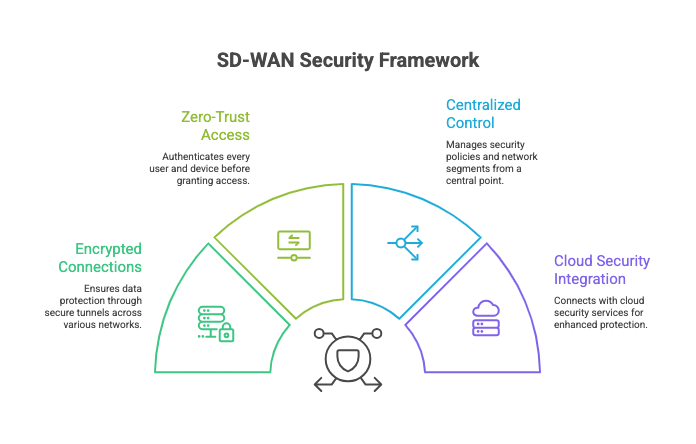
- Encrypted Connections: SD-WAN creates secure, encrypted tunnels using IPsec across any underlying network, like broadband or 5G. This ensures that your sensitive information is protected as it moves between different locations, such as your offices, data centers, and the cloud.
- Zero-Trust Access: Modern SD-WAN platforms use a zero-trust approach, which means they authenticate every single user, device, and application before allowing access. This strategy helps reduce the risk of a breach spreading, as access is based on identity rather than network location.
- Centralized Control and Segmentation: SD-WAN lets you create consistent security policies and network segments from a central point. You can easily place different types of traffic—like guest networks, corporate apps, or IoT devices—into their own secure segments that work across multiple clouds.
- Cloud Security Integration: Many SD-WAN solutions can connect directly with cloud security services like firewalls and Cloud Access Security Brokers (CASBs). This allows you to enforce security policies closer to your cloud applications without having to send all traffic back to a data center.
Making the Most of SD-WAN and the Cloud: A Simple Guide
Moving to the cloud is a game-changer, and SD-WAN is your best teammate. But to get the most out of them, it helps to follow a few simple best practices. This ensures your network stays fast, secure, and ready for whatever’s next.
Best Practices
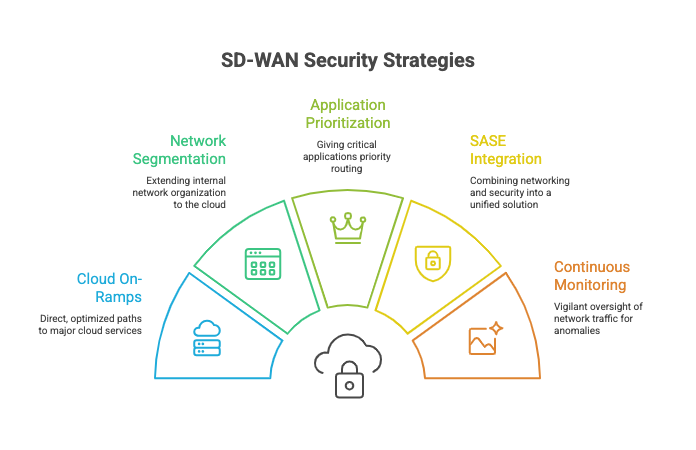
- Use Cloud On-Ramps: Think of these as express lanes. By using the built-in connections to major clouds like AWS, Azure, or GCP, you can create a direct and optimized path for your cloud workloads.
- Keep Your Network Organized: SD-WAN lets you extend your internal network segmentation (like VLANs) directly into your cloud environments. This means you can keep different types of traffic and devices neatly separated and secure, no matter where they are.
- Prioritize Your Most Important Apps: Use application-aware routing to give your critical tools—like ERP or collaboration platforms—the VIP treatment. You can make sure they get the best performance, while less sensitive traffic takes a different, less-prioritized route over the internet.
- Combine SD-WAN with SASE: For a powerful one-two punch, integrate your SD-WAN with a Secure Access Service Edge (SASE) architecture. This approach combines networking and security into a single, unified solution that keeps your entire operation safe and efficient.
- Monitor Everything: Keep a close eye on your network. Use the analytics and data from your SD-WAN to continuously monitor traffic flows between clouds. This helps you quickly spot any unusual behavior or issues before they become a bigger problem.
Final Thoughts
As enterprises expand deeper into multi-cloud environments, security can no longer be bolted on after the fact. SD-WAN provides a foundation where secure transport, zero-trust access, and centralized policy enforcement are built into the network fabric itself.
By combining SD-WAN with modern security models like SASE, organizations gain not only performance and flexibility, but also the confidence that their multi-cloud ecosystem is resilient against evolving threats.
Disclaimer: This post is for educational purposes only and does not endorse any specific vendor, architecture or solution.
