


DevOps changed how software is built and delivered. Version control, automation, testing, and fast feedback loops became standard. Networks, in many organizations, never fully made that transition.
For a long time, that was manageable. Networks didn’t change often, and manual processes worked well enough. That’s no longer true.
Modern networks support cloud platforms, SaaS applications, remote users, automation systems, and increasingly complex security models. They change frequently, and they fail in predictable ways when managed manually.
Network DevOps exists to address that reality.
Where Traditional Network Operations Fail
Most network outages are not caused by protocol bugs or bad designs. They are caused by operational issues:
- Manual configuration changes
- Configuration drift over time
- Lack of validation before and after changes
- Unclear ownership of the “real” network state
In traditional models, the running configuration on a device is treated as the source of truth. Engineers reconcile intent and reality by logging in and checking state by hand. That approach does not scale when networks change as often as applications.
Network DevOps replaces that model.
 From Device State to Intent
The core shift in Network DevOps is moving from state-driven to intent-driven operations.
In a state-driven model:
- Devices define reality
- Drift is expected and tolerated
- Rollbacks are manual and risky
In an intent-driven model:
- Desired behavior is defined in code and data models
- Devices are continuously reconciled against that intent
- Drift is detected and corrected automatically
Devices stop being the authority. They become rendered outputs of a system.
Configuration as a Rendered Artifact
One of the most common mistakes teams make is treating automation as a faster way to push CLI commands. That is not Network DevOps.
In mature environments:
- Engineers do not write device configurations directly
- They define structured inputs: networks, peers, policies, constraints
- Configurations are generated and rendered consistently
This enables predictable diffs, safe regeneration, and environment parity. If a configuration cannot be fully rebuilt from source, the system is fragile by design.
 Validation Is a First-Class Requirement
Applying a configuration successfully does not mean a change succeeded.
Network DevOps workflows include validation at multiple stages:
Before deployment
- Syntax checks
- Data model validation
- Policy and guardrail enforcement
After deployment
- Control-plane verification (neighbors, routing state)
- Data-plane checks (latency, drops, utilization)
- Service reachability testing
Operational state—not configuration output—is the measure of success.
 Idempotency and Drift Control
If automation cannot be safely re-run, it will eventually fail under real conditions.
Idempotent workflows assume:
- Partial state exists
- Devices reboot
- Engineers make mistakes
And still converge to the intended outcome.
This is how configuration drift is eliminated. Not through discipline, but through systems that continuously enforce desired state.
Telemetry as Feedback, Not Just Monitoring
Monitoring in Network DevOps is not limited to dashboards and alerts.
Telemetry feeds back into decision-making:
- Validating changes
- Detecting regressions
- Halting or rolling back deployments
This closes the loop between intent, deployment, and observed behavior. Without that loop, automation operates blindly.
Change Management Without Fear
Traditional networking treats change as a risk event. Network DevOps treats change as a controlled, reversible operation.
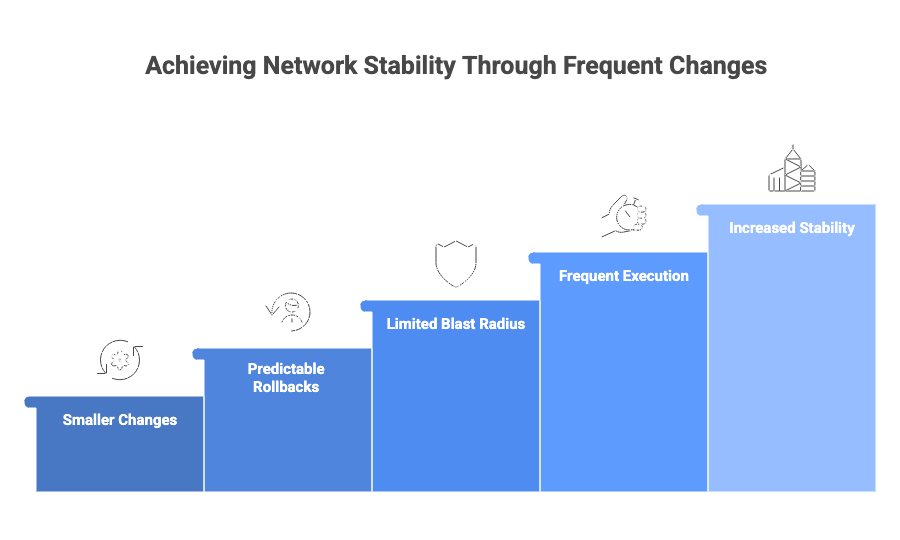
The focus shifts to:
- Smaller, incremental changes
- Predictable rollbacks
- Limited blast radius
- Frequent execution
Paradoxically, making changes more often increases stability, because large, risky updates stop accumulating.
 What This Means for Network Engineers
Network DevOps does not reduce the need for deep networking knowledge. It increases it.
Engineers still need to understand routing behavior, failure domains, QoS, and control-plane dynamics. The difference is where that expertise is applied: designing systems and models instead of repeating manual commands.
The question is no longer “Did I type the right configuration?”
It becomes “Does this system behave correctly under failure?”
Final Thoughts
Network DevOps is not a toolset and not a trend. It is an operational model built around repeatability, validation, and control.
At MZS Networks, we consistently see strong network designs undermined by outdated operational practices. Network DevOps fixes that by applying proven engineering discipline to how networks are built, changed, and maintained.
If your network depends on manual changes, tribal knowledge, or hope-based validation, it is fragile by definition. Network DevOps replaces that fragility with systems that are predictable, auditable, and resilient.
That is the real value.
