

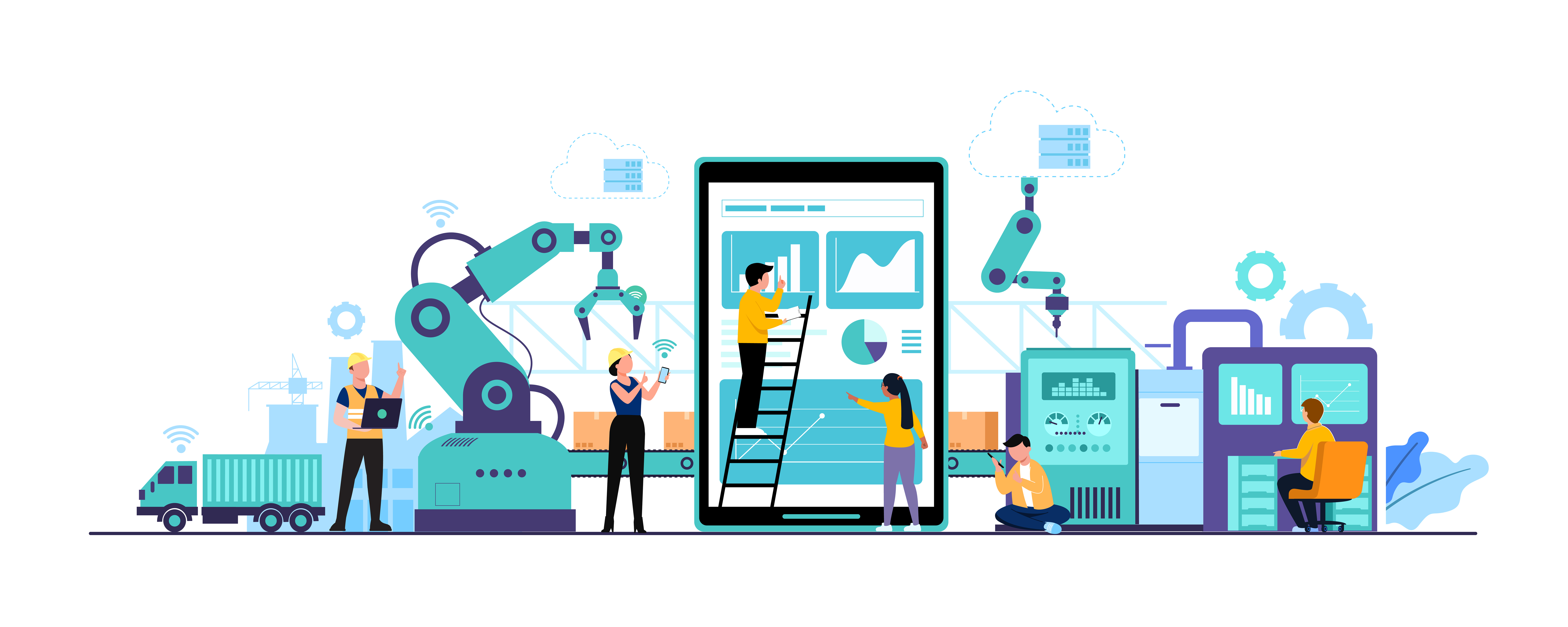
Industry 4.0 represents a monumental leap in manufacturing and industrial operations, symbolizing the convergence of digital, physical, and biological domains. This revolutionary paradigm shift often termed the fourth industrial revolution, is characterized by emerging integration and advanced technologies. It brings about transformative changes, opening the gates to intelligent manufacturing ecosystems where interconnectedness, intelligence, and automation are paramount.
This new industrial era leverages technologies such as the Internet of Things (IoT), Artificial Intelligence (AI), advanced robotics, and nanotechnology, seamlessly merging the capabilities of humans and machines. It signifies the move from traditional factories to intelligent environments where machines can communicate, analyze, and use data to drive intelligent actions. These innovative environments enable real-time responses to emerging challenges and opportunities, significantly departing from older industrial paradigms that relied predominantly on isolated and static production lines.
Industry 4.0 combines various innovative technologies to reinvent the manufacturing landscape. It’s about harnessing the power of data, being more responsive to market demands, and creating products more aligned with society’s evolving needs. It fosters an environment where innovation flourishes, processes are optimized, and industries become more resilient, sustainable, and competitive. As we delve deeper into the essence of Industry 4.0, we explore the groundbreaking innovations that are the building blocks of this industrial revolution, setting the stage for the future of manufacturing.
IoT (Internet of Things):
The Internet of Things has been a harbinger of change, establishing a network of interconnected devices, each embedded with sensors, software, and other technologies to exchange and accumulate data. In Industry 4.0, IoT enables seamless communication between machines, devices, and people, leading to unparalleled operational efficiency. It allows real-time monitoring of equipment and environmental conditions, facilitating predictive maintenance and minimizing downtime. The influx of data from various sources helps manufacturers make informed decisions, optimize processes, improve product quality, and reduce costs.
Cyber-Physical Systems:
Cyber-physical systems (CPS) are the integrative use of computer-based algorithms, embedded systems, and networks to monitor and control physical processes and feedback loops and manipulate the surrounding environment intelligently. In Industry 4.0, CPS plays a pivotal role in creating intelligent and autonomous systems, laying the foundation for smart factories. It fosters a seamless integration between computational and physical components, enabling advanced automation, real-time monitoring, and decentralized control, making manufacturing processes more adaptable and self-organized.
AI and Machine Learning:
AI and Machine Learning are the linchpins of Industry 4.0, offering capabilities beyond mere automation. They empower systems with the ability to learn from data, identify patterns, and make decisions autonomously. These technologies are instrumental in enhancing production efficiency and product quality in the manufacturing sector. They facilitate predictive maintenance, process optimization, waste reduction, and energy management, improving profitability and sustainability. Moreover, AI and Machine Learning enable the development of intelligent products and services, creating new business models and revenue streams.
Advanced Robotics:
The role of robotics in Industry 4.0 is transformative, with robots becoming more intelligent, autonomous, and capable of performing a wide array of tasks. Advanced robotics integrates sensors, AI, and other technologies, allowing robots to perceive their environment, process information, and execute tasks more efficiently. They can work alongside humans, learning from their actions and collaborating in shared tasks, enhancing productivity and safety. In Industry 4.0, advanced robotics supports flexible manufacturing systems, allowing quick adaptations to product design and demand changes, thus reducing time-to-market and operational costs.
Digital Twin Technology:
Digital Twin Technology in Industry 4.0 refers to digital replicating physical assets, processes, systems, or entire production lines. It allows manufacturers to create, test, build, and monitor products and processes in a virtual environment before implementing them in the real world. Digital Twins serve as a dynamic, real-time mirror of their physical counterparts, offering insights into performance, wear and tear, and operational efficiency. They enable manufacturers to predict failures, optimize performance, and implement enhancements, thereby reducing downtime, improving productivity, and fostering innovation.
Additive Manufacturing (3D Printing):
Additive Manufacturing, or 3D Printing, is at the forefront of Industry 4.0, enabling the creation of objects layer by layer from digital models. This innovation allows for rapidly producing complex and customized parts, prototypes, and final products, eliminating the need for molds and reducing waste. In the context of Industry 4.0, it supports just-in-time manufacturing, reduces lead times, and allows for localized production, thus minimizing the reliance on extensive supply chains. Moreover, it opens up possibilities for new designs previously unattainable with traditional manufacturing methods, driving innovation in product development.
Augmented Reality (AR) and Virtual Reality (VR):
AR and VR are transformative technologies in Industry 4.0, each with unique applications in the manufacturing sector. Augmented Reality overlays digital information onto the real world, aiding in training, maintenance, and assembly by providing real-time data and guidance. Conversely, virtual Reality creates immersive environments, allowing for the simulation and optimization of production processes, design visualization, and employee training. These technologies reduce errors, enhance productivity, and improve the quality of products and processes, providing industries with tools to visualize, interact with, and modify their creations in real-time.
Blockchain:
Blockchain technology is a decentralized and secure ledger system that provides transparency, traceability, and efficiency, especially in supply chain operations. Within Industry 4.0, it facilitates secure, tamper-proof systems for transaction recording, asset tracking, and contract enforcement. It ensures the integrity of the supply chain by allowing stakeholders to access real-time, unalterable information about the production, shipment, and receipt of products, enhancing trust among participants. Blockchain technology mitigates counterfeiting, fraud, and non-compliance risks and optimizes procurement, logistics, and inventory management.
Cloud Computing:
Cloud Computing provides scalable computing resources, data storage, and services over the Internet, enabling companies to access and analyze vast amounts of data without requiring extensive on-premise infrastructure. Industry 4.0 supports advanced analytics, real-time monitoring, and collaborative working environments, enhancing operational efficiency and decision-making processes. It facilitates the integration of various industrial applications, platforms, and services, allowing industries to be more agile, responsive, and innovative. Additionally, it supports developing and deploying new applications and services, fostering innovation and competitiveness.
Edge Computing:
Edge Computing processes data closer to where it is generated, at the network’s edge, rather than relying solely on centralized data centers. In the context of Industry 4.0, it reduces latency, conserves bandwidth, and enables real-time data analysis and insights, crucial for time-sensitive industrial applications. Processing data locally allows for quicker response times, enhancing the performance of industrial automation systems and reducing downtimes. Edge Computing empowers industries to analyze and act upon data in real-time, optimizing operational efficiency and facilitating predictive maintenance and quality control.
Advanced Energy Management:
In Industry 4.0, energy storage and management innovations are imperative for achieving sustainability and reducing operational costs. Advanced Energy Management Systems use smart technologies to monitor and control energy consumption efficiently. They leverage AI and data analytics to optimize energy use, identify inefficiencies, and provide insights for energy-saving opportunities. This enhanced focus on energy efficiency reduces emissions and a smaller carbon footprint, aiding industries in meeting environmental regulations and sustainability goals.
Customization and Personalization:
Industry 4.0 allows manufacturers to move from mass production to more customized and personalized production models. Advanced manufacturing technologies enable the economical production of small, custom batches of products tailored to individual preferences and requirements. This shift allows manufacturers to respond swiftly to consumer demands and market trends, offering products more aligned with consumer needs and values. It also allows for greater flexibility and adaptability in production lines, enabling manufacturers to switch between different product variations easily.
Smart Supply Chain Management:
Integrating intelligent technologies in Industry 4.0 has given rise to Smart Supply Chain Management, enabling more responsive, adaptable, and efficient supply chains. It utilizes IoT, AI, and data analytics to provide real-time visibility, predictive insights, and automated decision-making across the supply chain. It aids in optimizing logistics, improving inventory management, reducing lead times, and enhancing supplier and customer relationships. By embracing smart supply chain solutions, companies can mitigate risks, reduce costs, and improve overall performance.
Sustainable and Green Manufacturing:
Sustainable and Green Manufacturing practices in Industry 4.0 focus on minimizing the environmental impact of manufacturing activities. It involves adopting cleaner production processes, waste reduction, resource efficiency, and renewable energy sources. Companies also incorporate circular economy principles, focusing on designing products that are easy to recycle or remanufacture. These sustainable practices help in environmental conservation, drive innovation, improve brand image, and offer a competitive advantage in the market.
High-Performance Computing:
High-Performance Computing (HPC) provides the computational power to handle complex simulations, data analysis, and processing tasks in Industry 4.0. It enables the modeling and simulation of intricate processes, leading to the development of optimized production processes and innovative product designs. HPC supports advanced research and development activities, reducing the time and resources required to bring new products to market. It is instrumental in solving complex problems, analyzing large datasets, and accelerating innovations in manufacturing.
Nanotechnology:
Nanotechnology is manipulating matter on an atomic, molecular, and supramolecular scale and is pivotal in developing Industry 4.0. It opens the door for new materials and modifications with enhanced properties and functions, like increased strength, lighter weight, and better control of light spectra. Nanotechnology allows for innovations in manufacturing processes, contributing to the development of more efficient energy sources, improvement in health applications, and creation of smarter, more adaptable materials, which can revolutionize industries by providing solutions previously thought impossible.
Human-Machine Interface:
The Human-Machine Interface (HMI) in Industry 4.0 is the communication gateway between the user and the machine, enabling more efficient and intuitive interactions. Advances in HMI technology, such as touchscreens, voice recognition, and augmented reality, allow operators to monitor, control, and optimize machine functionality seamlessly. A well-designed HMI improves user experience, reduces errors, and enhances productivity by providing more precise insights into machine operations and allowing quick responses to any issues, enabling a harmonious symbiosis between human intellect and machine efficiency.
Autonomous Vehicles and Drones:
Autonomous vehicles and drones are revolutionizing material handling and logistics within and outside the manufacturing facility in Industry 4.0. They improve the efficiency of transport and delivery of goods, performing tasks that are time-consuming or risky for humans. Drones can access hard-to-reach areas to perform inspections, maintenance, or inventory checks, while autonomous vehicles can transport materials and products safely and efficiently. The integration of these technologies reduces operational costs, increases accuracy and speed, and optimizes the entire value chain from production to delivery.
Flexible and Modular Production Lines:
Industry 4.0 places a strong emphasis on creating production lines that are not only flexible but also modular, allowing manufacturers to adapt to changes in product design and market demand quickly. Flexible and modular production lines allow for easy reconfiguration and scaling, enabling manufacturers to switch between different products without significant downtime. This adaptability reduces time-to-market, optimizes resource utilization, and will enable manufacturers to respond swiftly to market changes, customer preferences, or disruptions in supply chains, maintaining a competitive edge in the dynamic market landscape.
Circular Economy Concepts:
The integration of circular economy concepts in Industry 4.0 represents a shift from a linear “take-make-dispose” model to a more sustainable, regenerative model focused on reducing waste and pollution, keeping products and materials in use, and regenerating natural systems. This approach mitigates environmental impacts, creates new business opportunities, and enhances resource efficiency. By emphasizing recycling, reusing, and remanufacturing, industries can minimize waste, reduce costs, and create more sustainable and resilient production ecosystems, aligning economic growth with environmental conservation.
Conclusion:
Industry 4.0 and its innovations are not just incremental improvements in industrial practices but represent a profound transformation in how industries operate and evolve. The amalgamation of intelligent technologies, advanced manufacturing techniques, and innovative practices creates a new industrial landscape characterized by efficiency, adaptability, and sustainability. This landscape is vibrant with possibilities, enabling industries to explore new frontiers in technology and create value propositions that were previously unimaginable.
This transformative journey through Industry 4.0 is about envisioning a future where industries are not just producers but innovators, where sustainability and profitability coexist, and where the boundaries between the digital and physical worlds are blurred. It’s about building a future where the synergistic relationship between humans and machines leads to unprecedented levels of productivity and creativity, addressing some of the most pressing challenges of our times.
The innovations integral to Industry 4.0 are reshaping the fabric of the industrial sector, pushing it towards a more inclusive, resilient, and forward-looking future. As industries embrace and integrate these innovations, they contribute to the advancement of manufacturing practices and play a pivotal role in shaping a world that balances economic growth with environmental conservation and social equity. The journey through Industry 4.0 is, thus, a journey towards building a more sustainable, equitable, and prosperous future for all.
