


Virtualization has become a key invention in the quickly changing field of information technology, changing many disciplines, most notably network administration. Multiple virtual instances can operate on a single physical system thanks to virtualization technology, which abstracts physical hardware resources. The design, implementation, and management of networks have undergone substantial modifications because of this paradigm shift. To demonstrate the significant impact of virtualization on network management, this blog post examines major technologies, advantages, difficulties, and future trends. It also provides case studies and particular examples.
Key Technologies in Network Virtualization
Several key technologies are included in network virtualization, and each one has a distinct role to play in its successful implementation:
Network Functions Virtualization (NFV)
NFV replaces traditional network devices like routers and firewalls with virtualized versions running on commodity hardware. This decoupling of network functions from proprietary hardware allows for more flexible and cost-effective network management.
Software-Defined Networking (SDN)
SDN centralizes network control by separating the control plane from the data plane. This approach provides a programmable interface for network management, enabling dynamic configuration and optimization of network resources.
Virtual Private Networks (VPN)
VPNs leverage virtualization to create secure, encrypted connections over public networks. They are essential for remote access and inter-site connectivity, ensuring data integrity and confidentiality.
Virtual LANs (VLANs)
VLANs segment networks logically rather than physically, improving network efficiency and security. They facilitate better traffic management and resource allocation within large networks.
Hypervisors
Virtual machine monitors, often known as hypervisors, facilitate the setup and administration of virtual machines (VMs). They are essential to network virtualization because they abstract physical hardware and give virtual machines (VMs) a separate environment.
Benefits of Virtualization in Network Management
The adoption of virtualization in network management offers numerous advantages, enhancing both operational efficiency and strategic capabilities:
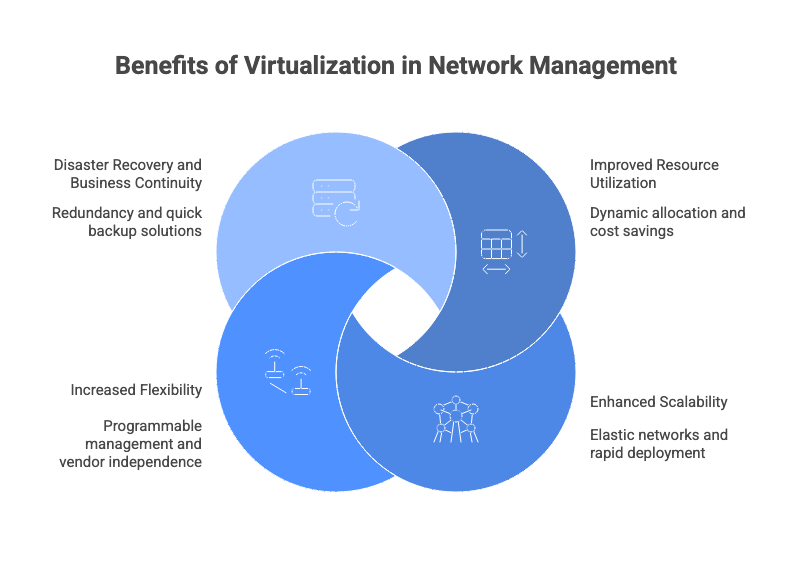
Improved Resource Utilization
- Dynamic Allocation: Virtualization allows dynamic allocation of resources based on demand, optimizing hardware utilization.
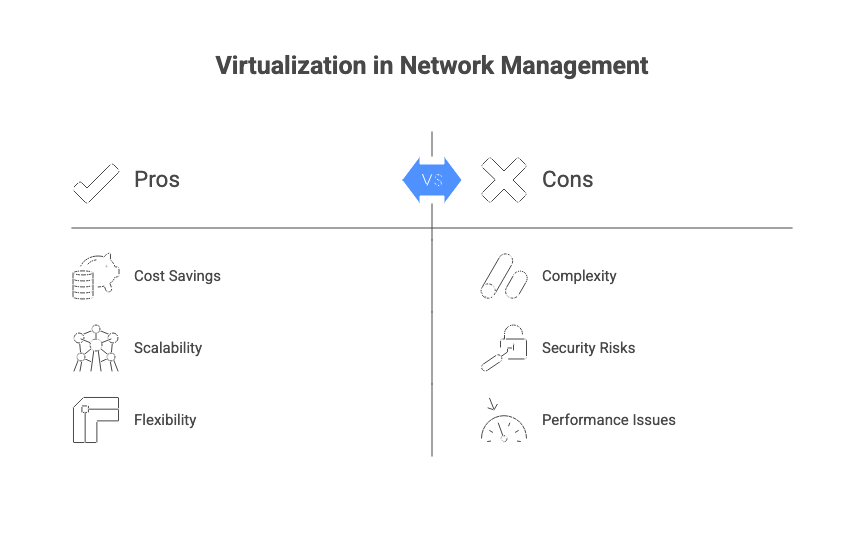
- Cost Savings: By reducing the need for dedicated hardware, organizations can achieve significant cost savings in both capital expenditures (CapEx) and operational expenditures (OpEx).
Enhanced Scalability
- Elastic Networks: Virtualized networks can scale up or down quickly in response to changing workloads, ensuring optimal performance and user experience.
- Rapid Deployment: New network services and applications can be deployed faster, reducing time-to-market for new initiatives.
Increased Flexibility
- Programmability: SDN enables programmable network management, allowing for automated configuration and real-time adjustments.
- Vendor Independence: Virtualization promotes vendor-neutral solutions, reducing dependency on specific hardware providers and enhancing interoperability.
Improved Disaster Recovery and Business Continuity
- Redundancy: Virtualized environments can easily replicate and migrate workloads across different locations, ensuring high availability and disaster recovery.
- Backup Solutions: Virtual machines can be backed up and restored quickly, minimizing downtime during outages.
 Challenges of Virtualization in Network Management
Despite its numerous benefits, virtualization also presents several challenges that organizations must address to leverage its potential fully:
Complexity
- Management Overhead: Virtualized environments can be complex to manage, requiring advanced tools and skills to monitor and maintain.
- Integration Issues: Integrating virtualized network functions with existing physical infrastructure can be challenging and may require significant reengineering.
Security Concerns
- Isolation: Ensuring proper isolation between virtual instances is critical to prevent cross-VM attacks and data breaches.
- Compliance: Maintaining regulatory compliance in a virtualized environment can be complex due to the dynamic and distributed nature of virtual networks.
Performance Overheads
- Resource Contention: Multiple VMs sharing the same physical resources can lead to contention and performance degradation if not appropriately managed.
- Latency: Virtualized networks may introduce additional latency due to the overhead of abstraction layers.
 Future Trends in Network Virtualization
The following are some of the emerging themes that are anticipated to shape the future course of network virtualization:
Edge Computing
- Decentralization: Edge computing lowers latency and boosts efficiency for vital applications by bringing processing closer to the data source.
- Integration with Virtualization: Virtualization at the edge enables efficient resource utilization and dynamic service deployment.
AI and Machine Learning Integration
- Automated Management: AI and machine learning can enhance network management by automating tasks such as anomaly detection, traffic optimization, and predictive maintenance.
- Proactive Security: Intelligent algorithms can identify and mitigate security threats in real-time, improving overall network security.
5G and Beyond
- Network Slicing: 5G networks leverage virtualization to create dedicated slices for different use cases, ensuring optimal performance and resource allocation.
- Enhanced Connectivity: Virtualized 5G networks provide improved connectivity, supporting a wide range of applications from IoT to augmented reality.
Hybrid Cloud Environments
- Seamless Integration: Virtualization facilitates seamless integration between on-premises and cloud environments, enabling hybrid cloud strategies.
- Flexibility: Organizations can leverage the flexibility of hybrid clouds to optimize costs and performance across different workloads.
 Case Studies and Examples
AT&T’s Network Transformation
AT&T embarked on a significant network transformation initiative leveraging NFV and SDN to virtualize its network infrastructure. This transformation resulted in:
- Cost Savings: Substantial reduction in hardware costs and improved operational efficiency.
- Enhanced Agility: Faster deployment of new services and improved network responsiveness.
Google Cloud’s Anthos
Google Cloud’s Anthos platform exemplifies the power of virtualization in hybrid cloud environments. Anthos enables:
- Unified Management: Centralized management of on-premises and cloud resources.
- Scalability: Dynamic scaling of applications across different environments, optimizing performance and cost.
Conclusion
Network administration has been significantly altered by virtualization, which provides unmatched efficiency, scalability, and flexibility. Although there are specific difficulties with it, they are much outweighed by its advantages, which make it a vital component of contemporary IT architecture. Virtualization will be essential in influencing network management in the future, spurring innovation, and helping businesses to adapt to the demands of a more interconnected world as cutting-edge technologies like edge computing, artificial intelligence, and 5G continue to develop.
