


Today, the growing digital landscape asks for more robust, adaptive, and intelligent networks. Today, it is no more about adding bandwidth or making sure the networks have more uptime than less. These would be the networks which would use predictive analysis, self-heal, and adapt to sudden bursts of traffic-all autonomously. Welcome to the future of network resilience where automation takes a better stage with its co-conspirators- AI and ML.
But what does the term “network resilience” really mean? It’s basically the network continuing in service, undisturbed, when events beyond its control, from simple glitches to widespread outages, hit it. That translates to reducing downtime and ensuring quick recovery while continuing to keep performance optimal, whatever the disruption might be.
As manual methods of network management-eardrums of the traditional type-fall increasingly behind demanding requirements, progressive organizations are using AI and ML-powered solutions to build more intelligent, adaptive, and autonomous networks. Below, we’ll look at how these next-generation technologies shape the next generation of resilient networks and what that looks like for IT teams moving forward.
What is Network Resilience?
Before we delve into the technology, let’s make clear the definition of network resilience. It goes beyond simply having redundancy or backup systems in place. A resilient network can:
- Predict Potential Failures: Using real-time data and trends, it can anticipate problems before they escalate.
- Automatically Adjust: When a problem occurs, it can reroute traffic, adjust configurations, or even deploy patches—all without human intervention.
- Quickly Recover from Failures: If downtime does occur, a resilient network can self-heal, restoring services in seconds.
Traditional network management has heavily depended on manual intervention to handle troubleshooting and recovery. However, due to intricate hybrid environments and a growing number of security threats, methods that rely on humans are no longer sufficient. This is when automation, artificial intelligence, and machine learning come into play.
The Role of Automation in Network Resilience
Modern network resilience strategies rely heavily on automation as a key component. It reduces mistakes made by people, accelerates reaction times, and enables the uniform implementation of policies and configurations. In a resilient network, automation can:
- Enable Proactive Maintenance
- Automation tools can proactively monitor system health, detect issues early, and address them preemptively to prevent performance degradation.
- Example: A large retail chain uses automated scripts to check for device misconfigurations and immediately roll back changes that could disrupt operations.
- Implement Automated Failover and Load Balancing
- Automated failover systems are capable of identifying when a network connection is not functioning and promptly redirecting traffic to an alternate route. Load balancers evenly spread out traffic among servers to prevent any one server from becoming overloaded.
- Scenario: During Black Friday sales, an e-commerce company’s network faced sudden spikes in traffic. Automated load balancing ensured that no single server was overloaded, preventing slowdowns and maintaining a smooth shopping experience.
- Orchestrate Configurations Across Hybrid Environments
- Maintaining configurations in hybrid and multi-cloud environments can be highly challenging. Automation tools help maintain consistent settings, minimizing configuration drift and ensuring smooth interoperability.
- Tooling: Tools like Ansible, Terraform, and Cisco NSO are popular choices for automating network configurations across diverse environments.
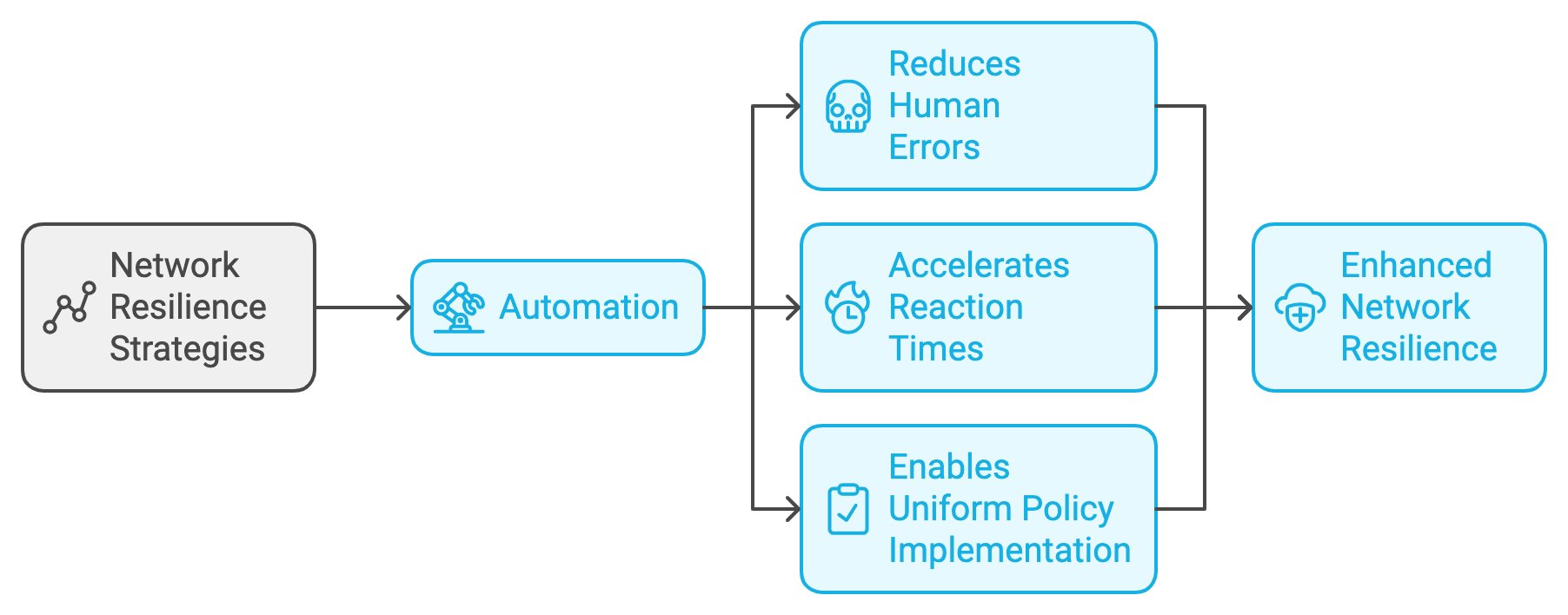
But automation alone can only go so far. To truly predict and adapt to network disruptions, we need to incorporate intelligence—this is where AI and ML come in.
How AI and ML Elevate Network Resilience
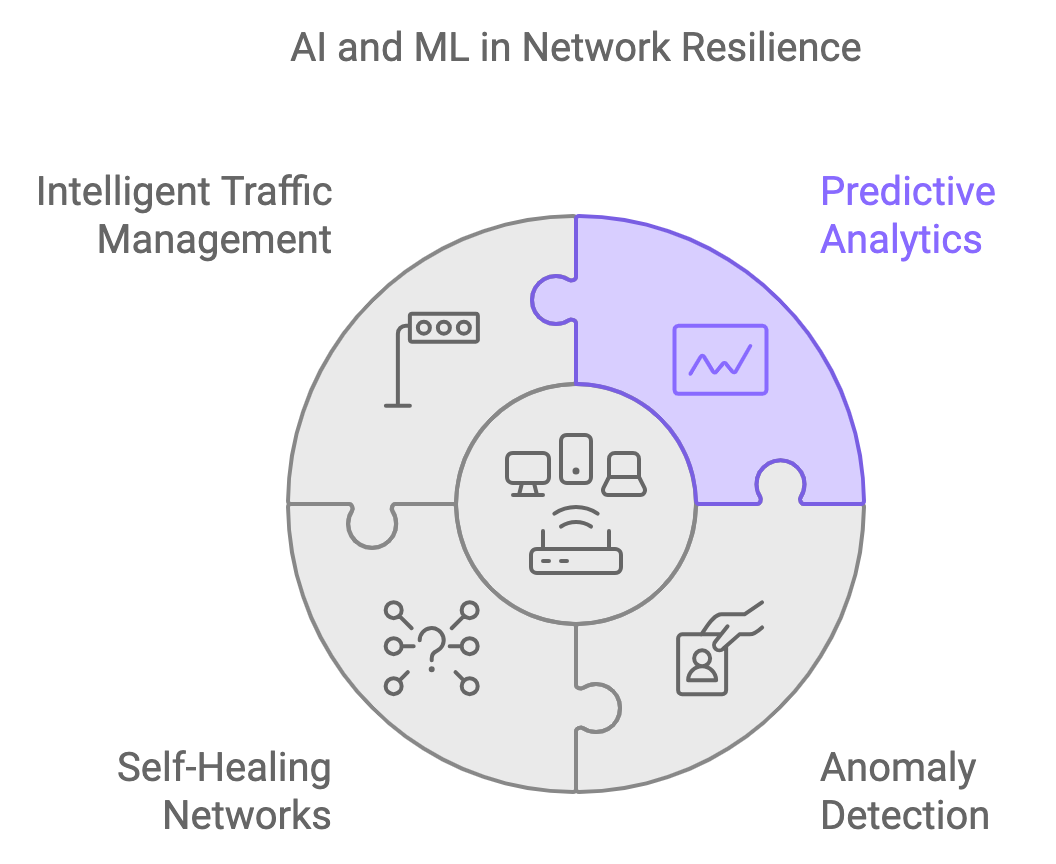
Although automation handles repetitive tasks, Artificial Intelligence (AI) and Machine Learning (ML) bring additional intelligence that allows networks to become aware of themselves and take proactive measures. Picture a system that gains knowledge from previous disruptions, comprehends traffic flow, and can predict problems in advance. Here’s how AI and ML are transforming network resilience:
- Predictive Analytics for Proactive Problem Solving
- AI and ML algorithms can analyze historical network data and real-time metrics to identify patterns that precede failures. This allows the network to alert administrators—or even take preventive actions—before a problem manifests.
- Example: A telecom provider uses ML models to monitor network latency, packet loss, and device health. The system predicts potential hardware failures days in advance, allowing for scheduled maintenance rather than emergency repairs.
- Anomaly Detection for Enhanced Security
- One of the biggest threats to network resilience is security breaches. ML algorithms can detect unusual behavior—such as sudden traffic spikes or unauthorized access attempts—that might indicate a cyberattack.
- Real-World Use Case: Google’s AI-powered security system detects and neutralizes phishing attempts and DDoS attacks before they can impact service availability.
- Self-Healing Networks
- The holy grail of network resilience is a self-healing network—one that can detect and fix problems autonomously. AI and ML enable this by continuously learning from past incidents and improving its response strategy.
- Example: A large financial services company uses a self-healing network that automatically reroutes traffic and adjusts firewall policies in response to detected anomalies, minimizing downtime and maintaining service availability.
- Intelligent Traffic Management
- AI has the capability to enhance traffic movement by analyzing current conditions. During a major event such as the Super Bowl, AI-powered network systems can predict and prioritize traffic to maintain the functionality of essential services.
- Scenario: A major streaming service uses AI to predict peak viewing times and dynamically adjust bandwidth allocation, preventing buffering issues even during the most popular live streams.
Overcoming Challenges in Building AI-Driven Resilient Networks
Of course, integrating AI and ML into network management isn’t without its challenges. To successfully build resilient networks, organizations must address:
- Data Quality and Availability
- AI and ML models are only as good as the data they’re fed. Incomplete or biased data can lead to incorrect predictions and actions. Establishing a robust data pipeline is essential.
- Scalability and Complexity
- Implementing AI in large-scale networks can be complex and resource-intensive. Scalability must be planned from the outset, and solutions should be designed to handle the volume and variety of data in real-time.
- Trust and Transparency
- IT teams may be wary of trusting AI-driven decisions, especially in critical areas like security and routing. Clear visibility into how models make decisions can help build trust.
- Integration with Legacy Systems
- Many organizations still rely on legacy hardware that wasn’t designed to support modern AI and automation frameworks. Finding ways to bridge the old with the new is crucial for a seamless transition.

The Future: Toward Autonomous Networks
In the future, the ultimate aim is to accomplish completely self-governing networks. These networks can repair themselves, as well as improve and defend themselves. They have the ability to adjust automatically according to traffic flow, give priority to essential applications, and optimize resource consumption to reduce operational expenses.
- Intent-Based Networking: One promising approach is intent-based networking (IBN), where administrators define high-level business outcomes (“ensure 99.99% uptime for critical applications”), and the network uses AI to configure itself accordingly.
- Digital Twins for Network Simulation: AI can also be used to create digital twins—virtual replicas of networks—allowing teams to simulate changes and predict impacts before making real-world adjustments.
The progression towards completely self-operating networks is only just beginning, yet proactive businesses are already making significant progress. With the advancement of AI, ML, and automation technologies, networks will evolve to not just react to issues immediately, but also predict and avoid them, establishing a higher level of resilience.
Conclusion
Automation, AI, and ML are the harbingers of a bright future for network resilience. Since networks are becoming complex and critical to business operations, creating intelligent self-adapting systems is no longer nice to have; it is an imperative. Through these technologies, it would be possible for an organization to move from reactive troubleshooting to proactive management, with its networks already prepared for whatever challenges may come along.
To the IT professionals and network engineers, this means embracing new tools, upskilling in AI and ML, and thinking out of the box. The resilient networks of tomorrow won’t just stay up-they’ll thrive, adapt, and evolve in ways we’re only beginning to imagine..
